
Dealer fees are one of the easiest financing costs to spot. They’re right there in the numbers, making them an obvious target when contractors start looking for ways to cut expenses.
And understandably so. Nobody wants to pay more than they have to.
But focusing too heavily on dealer fees can distract you from a much bigger question: How much revenue is your financing partner actually helping you capture?
That’s why evaluating a financing partner based on fees alone can be misleading. The real financial picture includes what you’re paying, what you’re closing, and what you could be missing.
The Sales Metric You’re Not Tracking
Think about the last homeowner you visited who needed a new system, applied for financing, got declined, and never came back. You likely never logged in detail these visits as financing declines. On paper, they simply look like lost jobs.
That’s where incomplete tracking can hide a meaningful growth opportunity. A declined application isn’t just a lost job. It’s a signal that there may be an opportunity to improve your financing strategy and win more installs.
One simple metric can start making that opportunity visible:
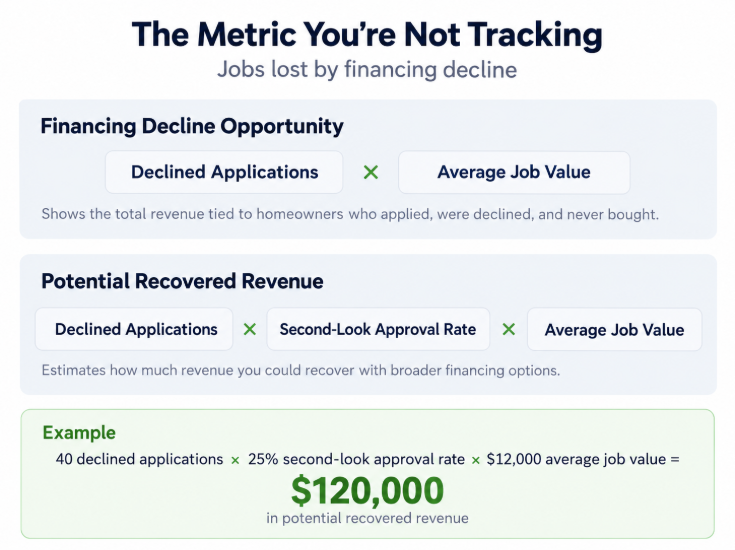
Financing Decline Opportunity = Declined Applications × Average Job Value
And if you want to estimate how much revenue a stronger financing strategy could potentially recover:
Potential Recovered Revenue = Declined Applications × Second-Look Approval Rate × Average Job Value
For example, if 40 homeowners are declined in a year, your average replacement job is $12,000, and additional financing options could approve 25% of those customers:
40 × 25% × $12,000 = $120,000 in potential recovered revenue
For a contractor doing a few hundred residential jobs a year, that gap can be the difference between a good year and a breakout year.
What Is Your Financing Partner Actually Costing You?
Dealer fees are easy to compare. One lender charges 5%, another charges 7%, and the lower-cost option looks like the obvious winner.
But that comparison doesn’t tell you what either lender is contributing to your business.
Consider two financing strategies for a contractor with a $12,000 average replacement ticket.
| Financing Option A | Financing Strategy B | |
| Dealer fee | 5% | 7% |
| Financed jobs closed | 80 | 90 |
| Financed sales revenue | $960,000 | $1,080,000 |
| Total dealer fees | $48,000 | $75,600 |
| Revenue after dealer fees | $912,000 | $1,004,400 |
Illustrative example using the same average ticket size. Actual results depend on approval rates, conversion, financing mix, and other costs.
Option B costs an additional $27,600 in dealer fees. If you evaluated the two based on fees alone, you’d choose Option A.
But Option B also generates $120,000 more in financed sales revenue, leaving $92,400 more after dealer fees.
That doesn’t automatically mean Option B is more profitable. You still need to account for equipment, labor, overhead, and other job costs. But it does show why dealer fees alone can’t tell you which financing strategy delivers the strongest financial results.
The question isn’t simply how much financing costs. It’s what your business gets in return.
How to Make Your Financing Options Work Harder
Adding a second-look lender, lease-to-own, or Home Comfort-as-a-Service option can help you reach homeowners who might otherwise be declined. But having more payment solutions available doesn’t automatically mean you’re making the most of them.
The bigger opportunity is in how those options work together and how consistently your team uses them.
For HVAC, plumbing, and electrical contractors, a more complete financing approach comes down to four things:
- Expand your financing options. Give homeowners access to solutions that accommodate different credit profiles, budgets, and preferences, including traditional financing, second-look options, lease-to-own, and Home Comfort-as-a-Service.
- Bring those options together. A multi-lender waterfall platform connects financing solutions through one coordinated process. Rather than navigating lenders separately or deciding where to send an application next, your team can follow a defined sequence that prioritizes your preferred solutions and provides additional paths when a homeowner doesn’t qualify.
- Make financing part of every sales conversation. Train your team to introduce payment options early and present them confidently. Financing shouldn’t be something your comfort advisors turn to only after a homeowner objects to the price.
- Measure what’s working. Track approval rates, financing declines, dealer fees, close rates, and average ticket sizes. These numbers help you understand which financing options are contributing to sales and where you may still be losing opportunities.
When these pieces work together, financing becomes more than a way to help homeowners afford a purchase. It becomes a tool for improving sales performance.
Consider what even a modest improvement could mean for your business. A few more approved applications each month, a higher close rate, or an increase in average ticket size can add up quickly over the course of a year.
But those gains need to be measured against what you’re spending on financing. More approvals don’t automatically mean more profitable jobs, just as lower dealer fees don’t automatically mean a stronger financial return.
That’s why a complete financing strategy needs to do more than offer customers additional ways to pay. It should give you the visibility to understand which options are helping you close more jobs, increase revenue, and protect your margins.
The goal isn’t simply to finance more jobs. It’s to make financing more valuable.
Anuj Khanna, founder and CEO of Comfort Connect, explained how we’ve elevated the consumer financing strategy.
“We can have new contractors trained and live in about a week. Your sales professionals, field technicians, and admins can manage all your financing needs from a single platform. And, unlike single-lender consumer financing strategies, we present our dealers with granular data across all their consumer financing activities via our AI Hub, thereby facilitating transparency and more informed decisions by management.”
That’s the opportunity worth considering. When financing solutions support the way your team sells, homeowners have more ways to move forward with the work they need, and contractors have more opportunities to capture the full value of each job.
Ultimately, your financing partner should be evaluated on more than what it costs to finance a job. You should also understand what that partnership is helping your business earn.
Start Measuring the Return, Not the Fee
Evaluating a potential financing partner solely on fee percentage is like evaluating a marketing channel solely on cost-per-click, ignoring what it converts into.
A lower fee might save you money on every financed job, but what if that same financing partner is also limiting how many jobs you close?
The strongest finance strategy isn’t the one with the lowest fees or the highest approval rates. It’s the one that delivers the greatest financial return for your business.
Before evaluating your next financing partner, look beyond what you’re paying. Look at how many applications you’re losing, how many opportunities you’re converting, and what those sales actually contribute to your bottom line.
That’s where the real cost of financing starts to become clear.